
What is marriage according to Sanatan Dharma and why is marriage called a bond of birth and rebirth?
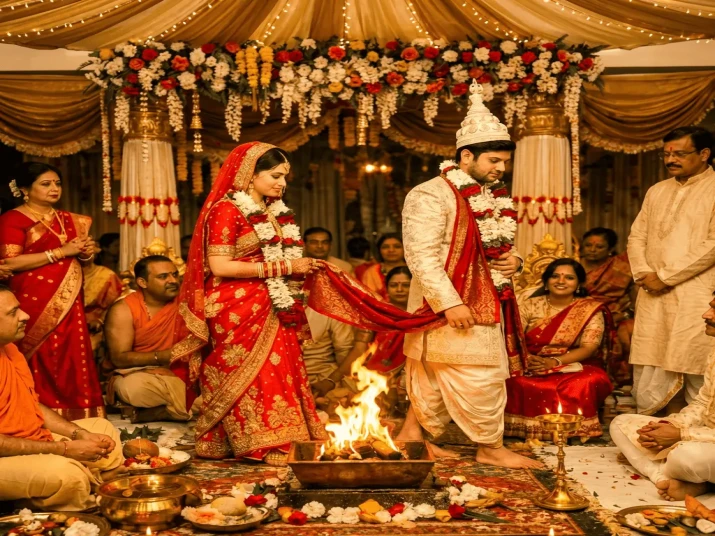
Table of Contents
- What is marriage according to Sanatan Dharma and why is marriage called a bond of birth and rebirth?
- How many types of marriages are there in Sanatan Dharma? Why is Brahma marriage considered the best among marriages?
- What is the main difference between a traditional religious marriage and a marriage in other religions?
- Comparison of religious reform of marriage in Sanatan Dharma and contract marriage or contract-based marriage in other religions?
- Why is fire made a witness during marriage? What is the religious significance of Sat Pak or Saptapadi?
- What does Shubh Drishti mean? What is the purpose of establishing Laz Hom?
- What is Kanyadaan and what is its religious significance? Does Kanyadaan degrade the dignity of women?
- How did a daughter's family status change after marriage? What is meant by a wife's 'stridhaan'?
- Why do wives not get a share of their father's property in the Sanatan Dharma? Is this a denial of inheritance to women?
- Why is a wife called a half-brother? How do they complement each other and achieve equal rights?
- Is it against the scriptures to marry for love? Is it unscriptural to not marry after being in a relationship for a long time?
- What are the duties of husband and wife in Sanatan Dharma? What is the role of marriage in forming a family and maintaining stability in society?
- What is the role of monogamy in protecting the dignity and rights of women? What are its provisions on divorce?
- Is the lack of mutual understanding between husband and wife the main reason for the increase in divorce in today's society?
- What are the main reasons why traditional marriages take place at night?
- What are some of the reasons why a married woman wears a conch shell and vermilion in Sanatan Dharma?
What is marriage according to Sanatan Dharma and why is marriage called a bond of birth and rebirth?
According to Sanatan Dharma, marriage (marriage in Hinduism) is a very important and sacred religious institution in human life. According to Hindu scriptures, there are sixteen sanskars or sixteen sacred rituals in human life. Marriage is one of them. It is not just a social or legal contract. Rather, it is an eternal bond bound by religious, moral, and spiritual responsibilities. Through this bond, a man and a woman enter the household ashram together and perform the dharma of the family. Through this sanskar, a man and a woman begin a new life. They not only enjoy married life. They move forward together on the path of achieving the four purusharthas of religion, artha, kama, and moksha.
The Sanatan system of life is divided into four ashrams. Brahmacharya, household, banaprastha, and sannyasa. Among these, the household ashram is called the center. Because in this ashram, a person performs the dharma of the family. He raises children and becomes a bearer of society and religion. Marriage is the entry into the domestic sphere. Therefore, marriage is not just a union of two people. It also establishes a sacred relationship between two families, two clans, and the larger society.
The word ‘marriage’ specifically means to bear. Here, bearing means accepting the responsibilities, happiness, sorrow, hopes, aspirations, and duties of each other. Husbands and wives are each other’s wives and companions. They are each other’s life partners, who promise to be there for each other in all situations of life. This relationship is given a permanent and sacred form through religious rituals, fire sacrifices, and chanting of mantras.
Therefore, marriage in Sanatan Dharma is not just a social or legal contract. Rather, it is a permanent bond bound by religious, moral, and spiritual responsibilities. And if there is a contract, there is an opportunity to break it after a certain period of time. But in a Sanatan marriage, the relationship is not seen as a transaction or a temporary agreement.
However, some societies, ideologies, and religions of the world have used marriage only as a social or legal agreement or strategy to enjoy married life. There, marriage is interpreted through a consumerist view of women. As if they can be used for sexual activities as desired and abandoned when the need arises. Such an attitude undermines human dignity and the sanctity of relationships. For example, if someone marries in their youth out of love. But later, they are abandoned in exchange for money, or a temporary relationship is formed and broken. It is undoubtedly deeply painful and immoral. Therefore, in the traditional concept, marriage is a sacred bond established on the ideals of mutual fidelity, responsibility, respect, and permanence.
In traditional religion, marriage is never a means of enjoyment or fulfilling temporary needs. It is a deep, sacred, and lifelong commitment. Here, the relationship between a man and a woman is not based on a transaction or contract. Rather, marriage is based on religion, responsibility, fidelity, and spiritual bonds. After marrying out of love, abandoning a partner in exchange for money, or breaking up a temporary relationship is completely unacceptable and immoral in traditional ideology. Marriage means walking together as a husband and wife throughout life, being by each other's side in happiness and sorrow. Therefore, in traditional concepts, marriage is a unique ideal of permanence, respect, and purity.
Also, in traditional philosophy, the four main goals or purushartha of human life are religion, money, lust, and salvation. Married life is considered a suitable field for achieving these four purushartha. Husband and wife are co-religionists. They perform religious practices, yagna, puja, and other social and family duties together. Practicing religion establishes a moral foundation in their lives. Earning money provides the status of running the family, lust ensures the natural happiness and love of married life, and ultimately provides the mental and spiritual strength to move forward on the path of salvation.
In the view of traditional religion, marriage is not just a union of two individuals. Here, it is a permanent bond of unity between two families and two souls. Through mutual respect, responsibility, loyalty, and sacrifice, this bond is strengthened and forms a stable foundation for social and religious life.
Why is marriage called a bond of birth and death?
In Sanatan Dharma, marriage is called a bond of birth and death because it is not just a worldly or social relationship. Rather, it is a deep spiritual union of two souls. According to Hindu philosophy or religion, the soul is indestructible. Although the body is perishable, the soul continues from one birth to another. From this perspective, the union of husband and wife is not just an event in the present life.
Rather, it is the result of the karma of previous lives and the continuity of reforms. Their relationship is not limited to one life, but continues in the process of reincarnation. Just as a river does not leave its source immediately. Rather, it flows along its path. Therefore, in the Sanatan view, marriage is not just a social bond. It is a permanent connection of souls. Which is developed beyond the boundaries of time and life. And is considered a symbol of a deep relationship between birth and death.
The promise made with fire as a witness during marriage and the seven pledges taken through the Saptapadi are considered lifelong duties. Husband and wife are called equals because they move forward together on the path of religion, money, lust, and liberation. The promise to stand by each other in the joys and sorrows of the world, in the achievements and failures, in the struggles and successes, deepens this bond.
This is why, in the traditional view, marriage is not just a social arrangement. It is an eternal relationship based on trust, sacrifice, loyalty, and spiritual unity. Which is considered an unbreakable bond from birth to birth.
How many types of marriages are there in Sanatan Dharma? Why is Brahma marriage considered the best among marriages?
In Sanatan Dharma, marriage is not just a social bond; it is a sacred Sanskar (one of the Sanskars). In Hindu scriptures, especially the Manusmriti, marriage is divided into eight types. This classification clearly reflects the moral outlook, social customs, and religious ideals of the ancient Aryan society.
The eight types of marriage in Sanatan Dharma are: Brahma, Daiva, Arya, Prajapatya, Asura, Gandharva, Rakshas, and Paisach.
In Brahma marriage, the father of the girl completely voluntarily and selflessly gives the girl to a scholar, virtuous and morally upright groom. It is not influenced by any kind of money, wealth, or worldly interests. The main goal is to establish religion, morality, and the welfare of the girl.
In a Daiva marriage, the father of the girl gives the girl to the priest who performs the yajna. Usually, this marriage was performed during a yajna or religious ceremony. In this, religious work is given prime importance, and giving a daughter is considered a virtuous act. However, its status is somewhat lower than in Brahmin marriage.
In an Aryan marriage, the father of the daughter gives a symbolic gift from the groom. Usually, he accepts one or two cows and gives the daughter as a gift. This gift is not the price of the daughter, but is accepted as part of the religious tradition. Simplicity and religious rituals are important in this.
In Prajapatya marriage, the father of the daughter advises the groom and the daughter to live together on the path of religion, duty, and morality. And the marriage is completed with that resolve. Here, the commitment to follow the household religion is the main thing. The ideals and sense of responsibility of married life is not given importance, but the ideals and sense of responsibility of married life.
In an Asura marriage, the father or guardian of the daughter accepts money, wealth, or valuables from the groom and gives the daughter in marriage. In this, giving a daughter is not a selfless religious act, but takes the form of a transaction. For this reason, it is considered equivalent to buying a daughter and is considered a lower marriage in the scriptures.
In a Gandharva marriage, the marriage is concluded based on mutual love and the complete consent of both the bride and the groom. It is not determined by any parental or social obligation. In the present society, it is generally known as a love marriage and gives prime importance to the free will of the bride and the groom.
In Paishacha marriage, the bride is taken by deception, force, or unconsciousness. It is completely immoral and condemned by both society and religion. This marriage is performed, ignoring the rights and honor of the bride. Therefore, it is considered the lowest and most punishable form of marriage in the scriptures.
Among these eight types of marriage, Brahma marriage is called the best. In it, religion, morality, and ideals are the basis of domestic life. Here, giving away a daughter is a sacred religious act, which is done completely selflessly. Considering the groom's knowledge, character, celibacy, and devotion, the main motive for giving away a daughter is not money or lust, but religious observance.
Brahman marriage establishes purity, family dignity, and spiritual values in society. It does not limit the relationship between husband and wife to worldly ties, but rather shapes it into a journey of achieving the four purusharthas of religion, money, sex, and salvation.
Therefore, although there are different forms of marriage in Sanatan Dharma, Brahman marriage is considered the best and most dignified marriage in terms of ideals, morality, and religious purity.
What is the main difference between a traditional religious marriage and a marriage in other religions?
Religious and ritual differences
In Sanatan Dharma or Hinduism, marriage is not just a union of two people. Rather, it is seen as a joining of two families and a religious social bond. It is a very important event from a spiritual and social perspective. The rituals of a Hindu wedding are extensive; it includes steps such as Saptapadi (seven steps), the bride wearing haldi, mangalsutra, and a sacrifice in the fire pit. This custom is not just a social event. Rather, it is considered a union of religious duties of both the bride and the groom and a symbol of spiritual bonding.
On the other hand, the rituals and views of marriage in other religions are different. In Islam, marriage is primarily seen as a legal and social contract (nikah). In Muslim marriages, instead of traditional yagna or mantras, the ceremony is performed according to the Quran and Hadith. Where prayers and the presence of witnesses are prominent. In Christianity, marriage is often considered a sacred bond of God. In Christian marriage, the main rituals are the taking of vows by the priest or priest in the church and the exchange of rings. In Buddhism, marriage is not particularly important from a religious point of view. It is mainly done according to social agreements and mutual commitments. Although there are pujas and prayers, there is no importance of yagnas or mantras like in Hinduism.
In summary, Hindu marriage is based on spiritual and religious rituals. Whereas in Islam, Christianity, and Buddhism, marriage is mainly dominated by social, legal, or mutual responsibilities.
2. Aims and perspectives of marriage
In Hinduism, marriage is not only seen as a social event. Rather, it is also considered a religious and spiritual bond and a bond between two families. The main aim of Hindu marriage is to form a family, to ensure the welfare of children, and to fulfill religious duties. Marriage is not just a union of two individuals. Rather, it is considered a union of two families and the fulfillment of social and spiritual responsibilities.
The view of marriage in other religions is somewhat different. In Islam, marriage is mainly seen as a means of peaceful family and legal relations. Muslim marriage emphasizes social stability and family responsibilities. In Christianity, marriage is often seen as a celebration of love and union with God. The main goal here is to combine mutual love and spiritual bonds. In Buddhism, marriage is not given much importance in terms of religion; rather, it emphasizes social bonds and mutual responsibilities. In Buddhist marriage, spiritual formalities are less important, but family and social harmony prevail.
In summary, in Hinduism, marriage is seen as a combination of love, spiritual, and social bonds. Whereas in Islam, Christianity, and Buddhism, the main goals of marriage are family stability, love, and social responsibility. The main purpose of marriage in each religion is dependent on the social and spiritual context.
3. Ceremonies and Rituals
The rituals of marriage are performed through different customs in each religion and reflect the religious and social context. In Hindu marriage, the ceremonies are completed by many days of rituals and religious rituals. It includes various pujas, chanting of mantras, and sacrifices in the fire pit. In addition, steps such as Saptapadi, Kanya Dham, Haldi, Mangalsutra, etc., are also performed. Each ritual in a Hindu wedding carries spiritual and social significance. It is considered a symbol of the religious responsibilities of both the bride and the groom.
In a Muslim wedding, the rituals are relatively simple and legally focused. A Muslim marriage is called Nikah, which is essentially a legal and social contract. The ceremony is completed with prayers, witnesses, and oaths. In some cases, adoption or exchange of gifts may also be included. Muslim weddings do not require traditional yajnas or mantras, but rather the ceremony is performed according to the instructions of the Quran and Hadith.
In a Christian wedding, the ritual is mainly held under the auspices of a church. Here, religious vows are taken by a priest or priest and usually an exchange of rings. In a Christian wedding, the couple is bound to the sacred bond of God through religious formalities such as oaths and prayers.
In summary, Hindu wedding rituals are the most extensive in terms of spiritual and religious aspects. While Muslim and Christian weddings are relatively simple, focusing on social and legal aspects, each religion's wedding rituals reflect its own traditions, beliefs, and family values.
4. Legal and Social Aspects
The legal and social aspects of marriage are defined differently in each religion. In Hinduism, marriage is legalized under the Hindu Marriage Act, 1955 (India). The law recognizes marriage as a socially recognized and legally protected relationship, not just a religious ceremony. In Hindu marriage, the process of marriage, age limit, family consent, and other legal matters are clearly defined.
On the other hand, there are separate legal rules and registration systems for Muslim and Christian communities. The validity of Muslim marriages is ensured by Muslim family law, where the relationship is legally recognized by means of nikah, witnesses, and necessary documents. In Christian marriages, the marriage has to be registered and approved by the church according to the Christian family law of the country.
In Buddhism or other minor religions, social consent and family customs are more important than legal norms. In these religions, marriages are usually recognized by family and social customs, and often, religious formalities are relatively limited.
In summary, Hindu marriage is well-structured both legally and religiously, whereas the legal framework of Islamic and Christian marriages is community-based and depends on the rules set by the country. In Buddhist and other religious marriages, social consent and family customs play a major role. These differences keep each religion's marriages connected to its own cultural and legal context.
In summary, the main difference between Hindu marriages is that they are performed through religious ceremonies and scriptural rituals. Where special importance is given to the spiritual union of the bride and groom. Marriages in other religions are comparatively social or legal obligations. Which are not centered on a specific perspective of the relationship with God. Hindu marriage is not just a union of two individuals; it is an expression of the spiritual bond connected to the family, society, and religion.
Comparison of religious reform of marriage in Sanatan Dharma and contract marriage or contract-based marriage in other religions?
In Sanatan Dharma, marriage is not only seen as a social or family bond. It is a sacred religious institution. In Hinduism, marriage or relationship is a part of religious duties and rituals, besides establishing a relationship between two individuals and their families. Marriage is called Samsara Dharma. That is, it is not just for the joy of married life. Rather, it is a means of fulfilling religious, moral, and social responsibilities. In Sanatan Dharma, various rituals are observed during marriage, such as Saptapadi (the unity of the bride and groom in seven steps), singing, and reciting various mantras. All these activities strengthen the marriage spiritually and socially. Here, marriage is not a contract. Rather, it is a religious and social bond, which is traditionally accepted to last a lifetime.
On the other hand, in other religions or modern sects such as Islam, Christianity, Judaism, or legal contractual marriage, the validity is mainly considered from the contractual or legal aspect. For example, in Islam, Nikah is valid, which is completed by fulfilling certain conditions. Here, the consent of the girl, the fixing of the price (mahar), and the presence of witnesses are required. In Christian or legal contract marriage, the consent of the bride and groom, registration, and legal obligations are important. In these cases, marriage is seen as a socio-legal contract.
The main difference is that in Sanatan Dharma, marriage emphasizes religious rituals and spiritual bonds. Whereas in other religions or contract marriages, the emphasis is on legality and legal obligations. In Sanatan Dharma, the central goal of marriage is the observance of religion, family life, and the preservation of generations. On the other hand, in a contract marriage, the goal is often rights, responsibilities, and social recognition.
Why is fire made a witness during marriage? What is the religious significance of Sat Pak or Saptapadi?
According to the ancient Indian belief, all work is done with the Sun or Fire as a witness. Because Fire is the revealer of truth and justice. Fire removes all lies, deceit, and darkness and shows people the path of light. It is not only for physical or worship. But also a symbol of moral and social responsibility. When Fire or Sun is kept as a witness. Then the person is forced to protect honesty, integrity, and justice in his work. This tradition reminds us that every work of ours is not just human. Rather, it is transparent and accountable to the great power of the universe. Therefore, keeping Fire and Sun as witnesses is a deep symbol of walking on the path of truth, justice, and light in Indian culture.
Marriage is not only a social bond in Sanatan Dharma. But it is also seen as a spiritual and religious relationship. From this perspective, Fire is made a witness at the wedding ceremony. Fire is considered a symbol of purity and divinity in Hinduism. Oaths and promises made in front of the Fire are considered pure, permanent, and unwavering. Therefore, when the vows given by the bride and groom to each other in front of the fire are completed, it becomes not only a social obligation, but also spiritually strong and irrevocable. It is considered a sacred oath towards the moral and religious responsibilities of married life.
Also, according to Sanatan Dharma, the root of all creation is fire. Because fire is a symbol of life and power. It is a manifestation of brotherhood, purity, and spiritual power. Fire is kept as a witness during marriage because fire is sacred and infallible. When the vows of the bride and groom are made in front of the fire, it is not only a social or family bond. It becomes spiritually strong and pure. Each vow is illuminated by the flame of the fire, which guarantees the moral, religious, and social responsibilities of married life. For this reason, in Sanatan Dharma, fire is considered a sacred and inseparable witness to marriage.
One of the most important rituals performed during marriage is the Sat Pak or Saptapadi. The bride and groom take seven steps together around the fire, each step of which is associated with a special promise or oath. In the first step, they take an oath to maintain friendship and sympathy towards each other. In the second step, they take responsibility for mutual happiness and peace. In the third step, they promise to protect the honor of the family and relatives. In the fourth step, they take an oath to ensure the progress of children and generations. In the fifth step, they promise to share each other's sorrows and hardships. In the sixth, they promise to perform religious and spiritual duties. In the seventh and final step, they promise to live together for the overall success and prosperity of married life.
Overall, Agni and Saptapadi are not just rituals or customs. Rather, they link marriage with spiritual, moral, and social responsibilities. They enter the couple into a new journey of life through a promise of love, brotherhood, responsibility, and spiritual values. In this, marriage becomes not just a social event, but a sacred and eternal bond.
What does Shubh Drishti mean? What is the purpose of establishing Laz Hom?
Shubh Drishti generally refers to sending love, good wishes, and positive energy through the eyes or gaze. It is not just a look towards a person. Rather, it is a symbol of goodwill, good wishes, and the desire for happiness and prosperity through the gaze. In traditional culture, it is believed that there is power in the gaze of the eyes as well. When someone gives a good look, it positively affects the life, work, or morale of another. It is not just a matter of beauty or external appearance. Rather, it is an expression of good wishes from the heart. The kind and sincere look that is expressed for children, the elderly, or anyone else. It is considered equivalent to a blessing through the gaze.
In those days, the groom and the elder bride usually did not meet before. Because the families of both had socially arranged the marriage. Therefore, their meeting before the wedding was considered the first meeting. It was very important that this first meeting was auspicious. For this reason, Shubh Drishti was practiced between the bride and groom. Which is a symbol of sending love, good wishes, and positive energy through the eyes. Besides, there was shyness and hesitation between the two due to not seeing each other before. To break that shyness and to build a sincere relationship, a laj homa was organized through a yagna. It ensured a comfortable, friendly, and spiritually balanced environment at the beginning of married life.
The main objective of establishing a laj homa is to provide a safe shelter and support to the helpless and insecure women of the society. Especially those who have been victims of violence, torture, or social deprivation for various reasons. The main goal of the laj homa is to ensure their rehabilitation and mental and physical safety. Here they get the opportunity to live in a safe environment, get opportunities for educational and skill development and get the opportunity to rebuild themselves. In addition, the laj homa provides mental support, healthcare, and social awareness. So that women can move forward in life with self-reliance and confidence.
In short, Shubhdhrishti is an expression of love and good wishes, which has a positive impact on people's lives. And laj homa is an important institution to protect and strengthen the lives of vulnerable women of the society by providing safe shelter, rehabilitation, and empowerment. Both concepts are based on human compassion, social responsibility, and love and support.
What is Kanyadaan and what is its religious significance? Does Kanyadaan degrade the dignity of women?
Kanyadan is an ancient religious ceremony in Hinduism. It is basically the practice of giving a daughter to her husband by her father or guardian at the time of marriage. The word means daughter, meaning daughter, and dan, meaning giving or giving a daughter. Through this ritual, parents send their daughter to the family of the in-laws. And it is considered an important social and religious ritual.
Kanyadan is considered a very pious act from a religious point of view. According to Hindu scriptures, Kanyadan is a gift where the fruit of virtue is equal to or greater than all kinds of relief. Gurusamatha scriptures such as the Mahabharata, Manusmriti, and Puranas mention that Kanyadan is a means of obtaining the blessings of God. In particular, Kanyadan is seen as a manifestation of parental responsibility and love for the child. The scriptures say that the one who gives a daughter, his family prospers, peace and religion improve.
Kanyadan is also important from a cultural and social point of view. It is considered a symbol of establishing the dignity and respect of the daughter. Since ancient times, this custom has been introduced to strengthen the status of women in society, social bonds, and the importance of moral responsibility in the family. Daughter-in-law marriage is considered not only religious in nature, but also as a means of strengthening social bonds and family relationships.
In the present era, although the ritual of daughter-in-law marriage has changed somewhat in modern society, its religious importance and social value are still relevant. In Hinduism, daughter-in-law marriage is not just a ritual; it is a symbol of virtue and an expression of duty towards family and society.
Does a daughter-in-law's marriage degrade women's dignity?
No, originally, daughter-in-law marriage or daughter-in-law marriage was not created with the intention of degrading women's dignity in Hinduism. Rather, in ancient scriptures, daughter-in-law marriage is seen as a symbol of virtue for parents and respect for their daughters. Daughter-in-law marriage is called the gift of virtue, where the daughter is added to the family with dignity and respect in society.
However, contemporary criticism shows that in some situations, the freedom and rights of women may be limited due to the social customs found in the daughter-in-law marriage. For example, showing a daughter as a giftable object or showing her value only through marriage. This view may partially diminish the dignity of women, but this is not the main intention of the original religious scriptures.
In modern society, the daughter-in-law is being re-evaluated as protecting the dignity of women and strengthening social bonds. And emphasizing family responsibilities. Therefore, from the right perspective, a daughter-in-law does not diminish the dignity of women. Rather, it can be considered a symbol of respect, care, and social harmony.
How did a daughter's family status change after marriage? What is meant by a wife's 'stridhaan'?
There was a special custom of changing the social and religious identity of daughters after marriage. She would leave her father's family or tribe and become a member of her husband's family. Where. Basically, if analyzed from the point of view of love, it can be seen that the wife would leave everything she had and join her husband's tribe and live in love. This change was not limited to the boundaries of family relations. Rather, it also affected her religious and social status. As a part of her husband's family, she would acquire new responsibilities, duties, and social status. Through this custom, the social bond within the family would be strengthened. And through new relationships, efforts would be made to maintain solidarity within the community or tribe. As a result, the identity of the daughter would not only be personal but would be directly linked to the social structure of the community and family. This custom had been prevalent in various societies since ancient times, which was basically considered part of the patriarchal social system.
The concept of 'stridhan' is particularly relevant here. Stridhan usually meant money, property, or gifts given to the wife by the husband or the husband's family at the time of marriage. It was a kind of economic security that ensured the daughter's position and status in her new family life. Sometimes, dowry was considered a right in her own right and gave her a dignified place in her husband's family. Dowry was not limited to money or wealth. Rather, it was also considered a symbol of social and family status. In many societies, dowry reduced the daughter's dependence on her husband and his family to some extent. And opened the way for her to become self-reliant.
In summary, after marriage, the family status of the daughter basically changed from the paternal clan to the maternal clan. This shift shaped her social, cultural, and economic responsibilities in a new way. Dowry served as an important part of that change. It ensured the daughter's status and security and helped her to get used to the new environment. As a result, marriage was not only a union of two people. It was also considered the beginning of a significant change in the life and family status of the daughter.
Why do wives not get a share of their father's property in the Sanatan Dharma? Is this a denial of inheritance to women?
Sanatan Dharma is a religion of love, respect, and complete surrender. In it, the wife surrenders herself completely to her husband. She accepts the responsibilities of the family and husband without prioritizing her own tribe and personal interests. There are equal rights and responsibilities between the wife and the husband. According to the scriptures, the husband cannot sell the property of the ancestors. In Sanatan society, neither a woman nor a man can abandon the land or property of the ancestors for personal interests. Rather, they will protect and preserve it and increase it for future generations. The main purpose of this trend is to ensure the stability of the family, society, and religious values. In Sanatan Dharma, mutual understanding, responsibility, and self-sacrifice between husband and wife are considered the main foundations of a happy family.
Also, in Sanatan Dharma (Hinduism), in ancient times, due to the influence of social and religious customs, the role of women was limited within the family. In ancient society, property was mainly a symbol of the security and power of men. Since men were at the head of the family, lineage, and religious activities, they owned property. Therefore, daughters or wives were considered to have no rights in the property of their father's house.
However, according to Sanatan Dharma, after marriage, daughters joined their husband and his clan or family. That is, they were separated from their father's clan or family. Since property was mainly distributed to maintain the continuity of the family and clan. They did not have the right to sell. The responsibility of protecting the property of the previous husband and educating the next generation was in the hands of men. Therefore, daughters were not given a share in the property of their parents.
After marriage, the daughter's joining the new family is accepted. According to the social norms, the husband's family is responsible for the financial security of the daughter. As a result, daughters do not become part of the father's property. This custom was basically a social and religious custom to maintain the patriarchal lineage.
Another reason is the rules related to family and lineage. In Hindu scriptures, the rules of patriarchal lineage generally prevail. That is, property passes down through the sons. Girls join the husband's family after marriage. Therefore, giving them a share in the property of their father's house is socially unconventional and legally restricted.
Religious texts such as Dharmashastra mention that girls take shelter in their husband's family after marriage. Therefore, to get their father's property, it was considered appropriate to run the family through the husband and children instead of depending on the daughters. In addition, this rule has been prolonged due to the lack of economic independence of women in society and the dominance of men.
In short, girls did not get a share in their father's property because they joined their husband's family and left their father's tribe. According to today's modern law, this rule has changed, and girls get equal rights.
However, currently, in Hindu law and modern society, girls get equal rights to their father's property. With the amendment of the Hindu Succession Act in 2005, girls also have the opportunity to get an equal share in the undivided property of their parents. This proves that ancient religious and social customs have changed with time.
The reason why women were not allowed to inherit property from their father's house in traditional Hinduism was due to social customs, religious norms, and the practice of patriarchal lineage, which has been amended in modern law and society to ensure equal rights.
Why is a wife called a half-brother? How do they complement each other and achieve equal rights?
The proverb that a wife is called an Ardhangini is often used in our social and cultural practices. It basically indicates that a wife and a husband complement each other. From a classical point of view, a person cannot be said to be divided into two parts. Rather, a completeness is created when a man and a woman meet with each other's individual identities. The word Ardhangini is a symbolic expression of this union. Which means that a wife is not just a partner in household chores. Rather, she is a life partner, morale, and moral support for her husband. That is, a woman plays an equally important role in every aspect of her husband's life.
The perfection of a relationship comes only when both parties give each other equal status. A woman and a man help each other meet their physical, mental, and social needs. For example, a husband contributes to the security and responsibility of the family. A wife contributes to mental peace, compassion, and care for the home. These unions complement each other. If one party is given priority, or the other party is underestimated. Then the balance of the relationship is lost. Therefore, mutual respect, understanding, and cooperation are essential to establish equal rights.
According to the modern view of society, women are not limited to household responsibilities only. Women are equal partners with men in education, profession, and social fields. If a man supports his wife in her dreams and efforts. And a woman plays an equal role in her husband's decisions and responsibilities. Only then does a relationship become complete. Calling a wife a half-brother is not just a cultural concept. It is a symbol of human and social equality.
Therefore, the word half-brother does not underestimate the different uniqueness of women. Rather, it illustrates the combined strength and equal rights of a husband and wife. When both accept each other as complementary, the structure of the family and society is strengthened. And human values are developed through relationships.
In this way, a wife and a husband come together as half-brothers and half-sisters of each other and strengthen the relationship based on perfection. Equality and understanding.
Is it against the scriptures to marry for love? Is it unscriptural to not marry after being in a relationship for a long time?
There are various misconceptions in our society about love and marriage. According to the scriptures, love is not forbidden. Rather, building a relationship with the right mind and following morality is supported. Love is not said to be against the scriptures, because the scriptures have acknowledged the importance of human feelings and love. It is also important to create mental and social harmony with each other before entering into a marital relationship.
Marriage is seen as a social and religious duty in the scriptures. But it is not compulsory. Even if someone does not get married after a long relationship. It is not an adharma if they follow morality towards themselves and each other. The main purpose of the scriptures is to manage the relationship in a healthy, safe, and responsible way. Therefore, just because there is love or a long-term relationship, it will not automatically be considered adharma.
Although the type of relationship and the timing of marriage are different in modern society, honesty, morality, and responsibility are important from the perspective of the scriptures. People who are in love or who have been together for a long time should consciously fulfill their mental and social responsibilities. If the relationship is respectful and comfortable, then it is not against the scriptures.
In short, love is not against the scriptures. To marry or not to marry is related to personal and social responsibility. Even if you have been in a relationship for a long time, not getting married is not wrong if it is conducted with honesty and morality. The main teaching of the scriptures is the advice to view love, relationships, and marriage in the light of human responsibility and morality.
What are the duties of husband and wife in Sanatan Dharma? What is the role of marriage in forming a family and maintaining stability in society?
In Sanatan Dharma, the relationship between husband and wife is not just seen as a personal bond. Rather, it is considered an important area of religious and social responsibility. The duties of husband and wife depend on showing trust, respect, and compassion towards each other. The duty of the man is to provide financial security to the family, maintain the dignity of the wife, and promote religious and moral education in the family. On the other hand, the duty of the wife is to manage the family. To teach the children the right values and to provide emotional and moral support to the husband. Both have to be sensitive to each other's needs and feelings.
In Sanatan Dharma, marriage is not just a social contract. Rather, it is considered the religion of the family, or the religion of life. Through marriage, an individual becomes responsible not only for his own well-being, but also for the well-being of the family and the stability of society. The cooperation, mutual respect, and duty of husband and wife lay the foundation for the formation of a well-organized family in society. Children grow up in this stable and fair environment and acquire moral and social values, which strengthen the society of the future.
Through marriage, social bonds are strengthened, and the continuity of justice, ideals, and reforms is maintained in the community. When the family is happy, the individual is mentally enriched and can actively contribute to the welfare of society. Therefore, in Sanatan Dharma, the importance of mutual responsibilities between husband and wife and marriage is not only for the family. It is considered the basis for keeping the entire society stable and well-organized. When the family is strong, the society is also strong, and this cycle paves the way for social peace and progress.
In summary, in Sanatan Dharma, the duties of husband and wife are mutual respect, compassion, and responsibility, which keep the family well-organized and happy. Marriage is that social and religious bond that ensures the development of the individual and the stability of society.
What is the role of monogamy in protecting the dignity and rights of women? What are its provisions on divorce?
In traditional religion and society, monogamy holds special importance in protecting the dignity and rights of women. Monogamy means that a man or a woman is bound to a one-time, permanent, and honorable bond in life. It ensures the mental and social security of women. Multiple marriages or polygamy can create physical, mental, and social pressure on women, which reduces their dignity. Through monogamy, women can maintain their independence, opportunity for education, and personal freedom. By establishing mutual respect and equality between husband and wife, women's rights and dignity are protected.
Marriage ensures a respectable place for women not only in the family but also in society. The structure of monogamy brings stability to the family. Which gives children the right education and values. When a woman knows her rights and her husband respects her. Then she is able to actively contribute to the development of the family and society. In this, women are not only safe but also get the opportunity to participate equally in society.
The provisions of divorce are also clearly mentioned in traditional religion. If the husband or wife is unable to fulfill their mutual obligations or fulfill their duties. Or there is a serious incompatibility or disagreement in the relationship. However, divorce is acceptable through legal and religious processes. Even if there is a divorce, the rights of women must be protected. For example, ensuring the right to joint property, separate living arrangements, and raising children. Therefore, divorce is not a failure, but a fair system for the welfare of a woman and her family.
In short, monogamy plays an important role in protecting the dignity, security, and social rights of women. It brings stability to the family and society. Proper implementation of the divorce system ensures protection and justice for women. With the correct regulation of monogamy and divorce, it is possible to protect women's rights and ensure a well-organized life in society.
Is the lack of mutual understanding between husband and wife the main reason for the increase in divorce in today's society?
Lack of mutual understanding between husband and wife can be said to be an important reason for divorce. But it is not the only or main reason. In reality, the increase in divorce is a multidimensional problem, which is influenced by various social, economic, psychological, and moral factors.
First, lack of mutual understanding: When husband and wife fail to understand each other's attitudes, needs, or feelings. Then dissatisfaction, conflict, and emotional distance are created. This weakens the discipline of the relationship and increases the risk of the relationship breaking down over time.
But other factors are also important. Economic pressures such as household expenses, job or business problems can increase conflict between husband and wife. Mental and emotional health problems, such as depression, stress, or temperamental differences, affect the relationship.
Also, due to greed or excessive demands, a married or related person has a secret or illicit love or physical relationship with someone other than their partner. This is morally and socially unacceptable because it violates the trust and respect of the marital relationship. This usually happens due to a lack of understanding between husband and wife, emotional distance, social or professional opportunities, and moral weakness. Extramarital affairs are not only harmful to the individual but also to the family; the stability of the relationship is destroyed, the psychological security of the children is reduced, and social status is damaged. The solution is to strengthen mutual understanding, trust, and moral education.
Social changes and differences in values are also one of the reasons for the increase in divorce. Today, the level of education, career needs, independence, and social mentality of women and men are different than before. As a result, it has become difficult to maintain unity within the family as before.
Social acceptance and legal benefits also play a role. Earlier, divorce was viewed with coldness in society. Now, due to legal benefits and social acceptance, people easily choose the path of separation.
In short, although a lack of mutual understanding is an important reason for divorce, it is not the only one. The divorce rate is increasing in today's society due to a combination of economic pressure, psychological and personal inequality, social changes, and legal benefits. The solution lies primarily in increasing communication, empathy, and mutual understanding in relationships.
What are the main reasons why traditional marriages take place at night?
1. Religious rituals and auspicious times of marriage:
Hinduism has an ancient tradition of determining auspicious times according to the calendar, dates, and stars. According to astrology, the special positions of planets and stars affect a person's life, so it is better to complete important rituals like marriage at a specific auspicious time. Many times this auspicious time falls at night. Priests determine that specific moment by judging the horoscope and planetary positions. It is believed that getting married at that exact time removes the evil effects and brings happiness, peace, and prosperity in married life. Therefore, night weddings were organized in accordance with religious rules.
2. Historical reasons:
During the Mughal Empire in North India, the security of the common people was a major concern due to political instability, regional conflicts, and banditry. Wealthy families were especially worried because gold ornaments, precious clothes, and huge wealth were displayed at social events like weddings. This increased the risk of attacks by bandits or looters. In this situation, many families used to arrange marriages in the dark of night, behind the scenes, so that the safety of the wealth and the bride could be ensured. Gradually, this custom became a social custom, and the next generation followed it as a tradition. As a result, night marriages eventually became a cultural tradition due to the need for security.
3. Importance of Astrology:
According to Hindu astrology, the movement of planets and the position of stars have a profound effect on human life. The vast Parashar Hora Shastra describes various rules for determining auspicious times for marriage. Many auspicious yogas and constellations are formed at night. Therefore, based on astrological calculations, the night is considered more suitable, so that the evil effects in married life are reduced, and good luck increases.
4. Aesthetic and Cultural Atmosphere
A unique aesthetic atmosphere is created at night weddings with the combination of lamps, lighting, and music. The soft atmosphere of light and shadow, the sound of conch shells, and the chanting of mantras make the ceremony more solemn and festive. In ancient times, the wedding hall was decorated with oil lamps and flame lights, which made the ceremony more sacred and attractive. This cultural atmosphere has given special dignity and emotion to night weddings.
5. Marriage with fire as a witness:
In Hindu marriage, fire is considered a deity and a witness. The seven verses (saptapadi) and mantras are performed around the fire. In the silent and still atmosphere of the night, the flames of the yajna and the Vedic mantras create a deep spiritual atmosphere. This increases the solemnity of the ceremony, and everyone present can easily concentrate. As a result, the marriage becomes more sacred and meaningful.
6. Calm and cool environment:
In ancient India, there was extreme heat and busyness during the day. Especially in tropical regions, it was difficult to perform long religious rituals during the day. The cool and comfortable weather of the night is more relaxing for the guests and the bride and groom. Although the ceremony is long, it reduces fatigue. It is believed that the practice of night weddings has developed out of practical necessity.
7. Spiritual atmosphere:
The night is often considered suitable for meditation, prayer, and worship. The mind is easily concentrated as the surroundings are calm and silent. Marriage is not only a social contract, it is also a sacred religious ceremony. Therefore, its significance increases when it is performed in a deep spiritual atmosphere. Night is considered helpful in maintaining that solemnity and purity.
8. Belief in receiving the blessings of the gods:
According to the Hindu religion, the influence of divine power is particularly effective at certain hours. It is believed that if the marriage is performed in auspicious times, the blessings of the gods are obtained and the married life is prosperous. Therefore, a specific time of the night is considered especially sacred. Due to this belief, many families attach importance to night weddings.
9. Social Benefits:
In the past, people were busy with farming or livelihood activities during the day. After finishing work at night, relatives could easily get together. As a result, it was convenient to organize large-scale social events. Thus, real social needs made night weddings popular, and it gradually became a tradition.
10. Customs and Traditions:
Night weddings have been established as a social custom for many generations. Maintaining the rituals followed by ancestors is considered a religious and cultural responsibility. Therefore, many families organize night weddings in the interest of preserving tradition. Continuity of customs and culture plays a major role here.
11. Influence of the Moon:
In Hindu belief, the moon is a symbol of peace, tenderness, and good fortune. The light and influence of the moon are felt at night. Many believe that the auspicious influence of the moon increases the mental state and love in married life. Therefore, night is seen as an auspicious time for marriage.
12. Scriptural instructions:
In various religious scriptures, including the Manusmriti, marriage has been mentioned as an important reform, and great importance has been given to the selection of an auspicious time. According to the scriptures, the appointed moment often falls at night. Therefore, families prefer night weddings to comply with the rules of the scriptures.
13. Climate and comfortable environment:
The climate of the subcontinent is generally hot and humid. In ancient times, due to the lack of air conditioning, it was difficult to organize large events in the intense heat of the day. It was quite difficult to conduct pujas, yagnas, and entertain guests for a long time during the day. In the comparatively cool and comfortable environment of the night, everyone could participate comfortably. This would have made the bride and groom, the priest, and the guests less tired, and the ceremony could have been completed without any problems. Therefore, the practice of night weddings developed for practical and natural reasons.
14. Length of rituals:
Traditional Hindu weddings involve many stages of rituals. Such as Mangalacharan, Kanyadan, Agni Sakshi, and Saptapadi. Each ritual takes time to complete according to specific mantras and rules. During the day, busyness and environmental noise could hinder the performance of these long rituals. Since the nighttime is relatively quiet and peaceful, it was easier to complete the ceremony step by step correctly. As a result, nighttime was established as a suitable time for weddings.
Special Note: In many parts of the Deccan or India, weddings are also common during the day. However, in North India and Bangladesh, the custom of night weddings is relatively more common, which is the result of historical habits and social continuity.
What are some of the reasons why a married woman wears a conch shell and vermilion in Sanatan Dharma?
1) Social and moral protection
In Sanatan Dharma, the custom of a married woman wearing conch shell and vermilion is not just a ritual. Behind it is a cultural identity rich in deep social and moral significance. Conch shell and vermilion give a woman a special status in society as a visible sign of her marital status. Through this sign, society can easily understand that she is married. As a result, a moral reform is developed to respect her with maternal knowledge. Behind this is the thought of maintaining social order and awakening a sense of mutual responsibility. Also, socially, it creates a kind of protective circle so that no one gives bad advice. And the men of the society consider it their duty to give her respect and protection. Therefore, this custom is a traditional reform deeply connected with the dignity, security and social identity of a woman.
2) Symbol of marital identity
In Sanatan Dharma, conch shell and vermilion are clear and dignified symbols of the marital status of a married woman. If she has vermilion on her fingernail and a conch shell in her hand, society can easily understand that she is married. Since ancient times, this symbol has given social recognition to a woman's marital identity. It is not just a personal ornament, but a cultural declaration. She is part of a family and is bound to married life. In many cases, this symbol was also associated with the social security and respect of a woman. In rural society as well as in urban society, conch shell and vermilion are considered important expressions of marital identity.
3) Wishes for the husband's longevity and well-being
Wearing vermilion is associated with the wish for the husband's long life, good health and well-being. Such a belief has been prevalent for a long time. Sindoordan is a major ritual in Hindu marriages, where the husband initiates the marital bond by putting vermilion on his wife's fingernail. Since then, the wife wears vermilion every day and wishes for the husband's well-being. Wearing conch shell is also considered an auspicious and protective symbol. This ritual is an expression of the wife's love, sense of responsibility and commitment to the family. According to religious beliefs, wearing conch-vermilion regularly brings stability, peace and prosperity to married life.
4) Symbol of good power and fortune
The red color of vermilion is considered a symbol of power, love, fertility and fortune. Red is the color of goodness and auspiciousness in Hindu culture, which is especially used in weddings and festivals. Since the conch is white, it is a symbol of purity, peace and purity. The combination of these two colors expresses the presence of balance, power and peace in married life. Many believe that conch-vermilion keeps away evil forces and instills positive energy in the world. Therefore, it is not just an ornament, but is considered a symbol of invocation of good power and good fortune.
5) Religious and mythological inspiration
In Hinduism, Goddess Parvati is considered the ideal form of marital happiness and fortune. She is a symbol of devotion to her husband and protection of the family. In mythological stories, goddesses are seen wearing horns and symbols of good fortune. It is from that inspiration that married women are believed to wear conch shells and vermilion. This custom is also considered an expression of religious devotion and trust. Many women believe that this ritual provides them with spiritual strength and brings stability and blessings in their married life.
6) Tradition and Cultural Continuity
Conch shells and vermilion are not just religious rituals. They are an important tradition of Bengali and Indian culture. From generation to generation, mothers teach their daughters this custom, which strengthens family bonds. Wearing conch shells and vermilion for the first time after marriage is an emotional and memorable moment. It gains special importance in social events, pujas and festivals. In modern times, many women wear it or not according to their personal preferences, but its cultural value is unwavering. This custom carries the glory of married life, family unity and continuity of tradition.
Tags
For Add Review. You Need To Login First Login Page
-
LATEST
-
POPULAR
What is marriage according to Sanatan Dharma and why is marriage called a bond of birth and rebirth?

The Sydney attack is also the result of the same petro-dollar, Pakistan and Deep State radical narratives.

Comments
No comments yet